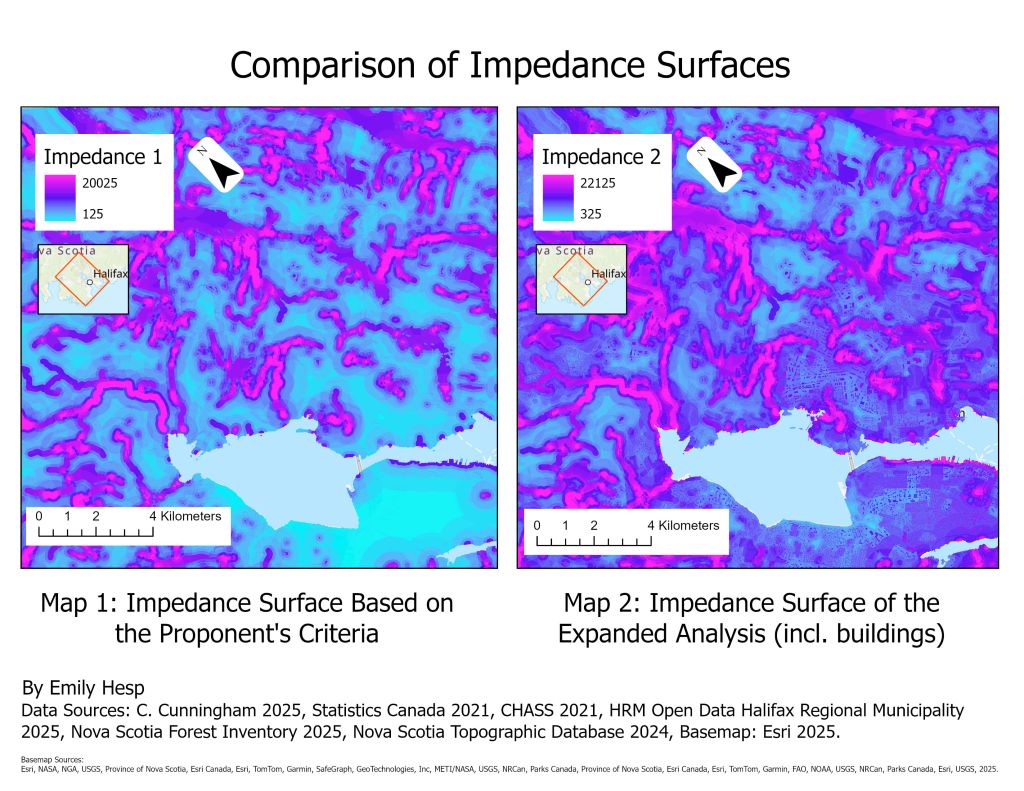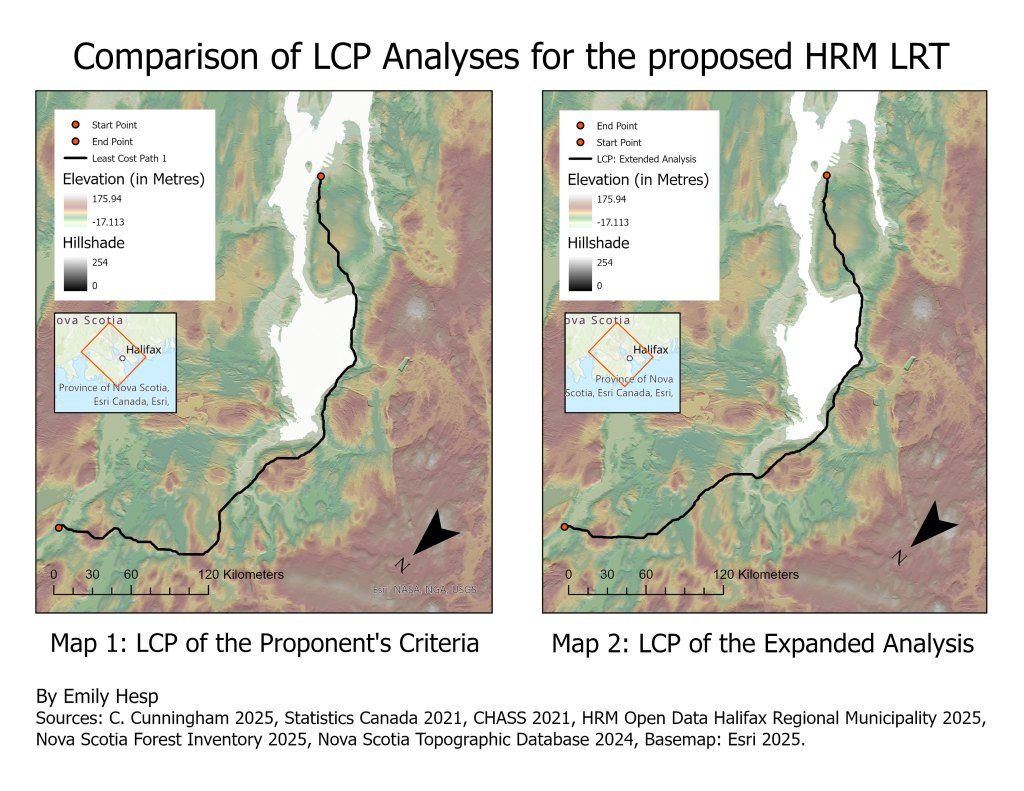
This project was completed for one of the two Independent Projects assigned in the second GIS course I took last year. These projects had us apply the theory and ArcGIS pro techniques we had learned to analyze spatial data for a given scenario. For this particular project, students applied their knowledge of advance raster operations, cost surfaces and data preparation to complete a geospatial model of a new Light Rail Transit line. This new LRT line would connect the peri-urban edge of the Halifax Regional Municipality to its downtown centre.
This project furthered my knowledge of how transit planning decisions are informed by biophysical, socio-demographic and economic data. In the expanded analysis, I explored how mixed-use Transit Oriented Communities (TOCs) can support sustainable transit development in the long-term. Learning about TOCs gave deepened my understanding of the intersection between regional economic development, housing supply and effective transit planning.
This project was very fun to complete, and it definitely motivated me to continue exploring topics in economic geography through coursework and independent research. I hope to learn more about TOCs through my own geospatial analysis and research in the future.
A PDF of the final report in linked below. If you have any thoughts, questions, or suggestions, feel free to comment or reach out through my contact form!
I would like to acknowledge a few map layout errors in this report. I am currently experiencing a few hardware issues with my ArcGIS Pro setup and will update the maps once my new laptop is delivered at the end of the month.
When I revisit this map, I will…
- …Simplify the study map on page one. My professor informed me that the featured inset map would suffice as the study map. A new inset map at a smaller scale, showing the location of Halifax within the entirety of Nova Scotia, would also have been better.
- Add the following elements to the study map:
- the spatial reference and,
- a scale bar.
- …Use one north arrow and scale bar for the impedance surface and LCP analyses map layouts, respectively.
- …Add the spatial reference that is missing on both maps.
- …Correct the scale bar values on the LCP Analyses Comparison map, which are about 10 times what they should be. (They were likely referenced from the inset map)


Leave a comment